

Asem Bhakta
Special Correspondent North East
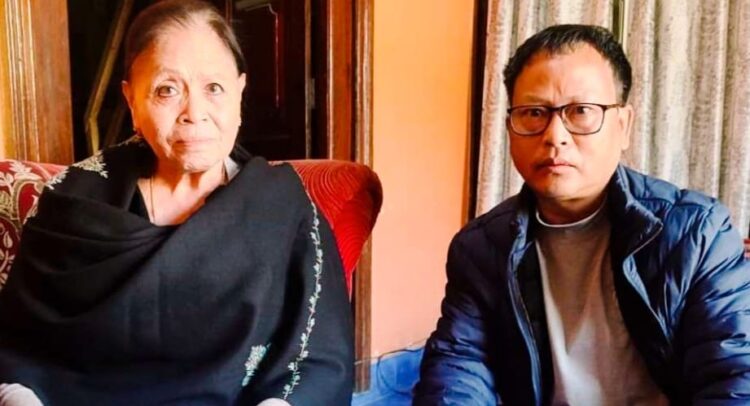
Imphal: In the cool stillness of January 1951, on the western bank of the Imphal River at Singjamei Mathak Chongtham Leikai in Imphal, a child was born into a humble family. No one could have known then that the youngest daughter of Late Dr. Laishram Kriti Singh and Late Rajkumari Sanatombi Devi would one day chart a course through Indian aviation history.
Born on 1 January 1951 in Imphal, Captain Laishram Binodini grew up with two brothers and a sister in a home that valued education and discipline. She completed her schooling at Tamphasana Girls’ Higher Secondary School (then Tamphasana Girls’ High School) and pursued her pre-university studies at D.M. College, Imphal.
From an early age, Laishram Binodini displayed remarkable athletic talent. She excelled in sports and represented her college at inter-state university competitions in Assam, where she set a record in the javelin throw. Her pursuit of excellence continued at Scottish Church College in Kolkata, where she graduated while once again distinguishing herself in badminton. She was awarded and adjudged the prestigious “Blue” title for her outstanding performance in badminton.
Her move from Imphal to Kolkata in 1967 proved transformative. Although she had long been fascinated by the idea of flying, her dream crystallized during a flight from Imphal to Kolkata, when she discovered that the aircraft was commanded by Captain Drubs Banerjee, a woman. Seeing a woman in the cockpit ignited something powerful within her. If another woman could command an aircraft, why not her ?
But the parents were not in favour of her joining the active profession. She convinced them and decided to try to see whether she could succeed or not. After graduating, she moved to Delhi in 1971 and enrolled at the Delhi Flying Club, supported by her eldest brother, Dr. Laishram Jogamani Singh, who was then working at Irwin Hospital in New Delhi. Eventually, her parents also agreed.
Yet the Delhi Flying Club, crowded with hobby flyers and serious trainees competing for limited flying hours, did not offer the focused environment she sought. In 1972, she shifted to Guwahati to continue her training under Chief Flying Instructor Captain Vijoy Singh and Flight Instructor Captain K.K.K. Singh( Kaminikumar singh). That same year, she earned her Private Pilot’s Licence (PPL).
Her journey toward a Commercial Pilot’s Licence (CPL) demanded perseverance. Training primarily on Tiger Moth and Pushpak aircraft, she finally secured her CPL in 1975, three years after earning her PPL. With that achievement, she became the first woman from Manipur and the entire Northeast to obtain a Commercial Pilot’s Licence—an extraordinary milestone at a time when aviation was overwhelmingly male-dominated.
The mid-1970s, however, were turbulent years for Indian aviation. An oversupply of pilots and limited employment opportunities created uncertainty. Amid growing media attention on unemployed pilots, the Director General of Civil Aviation (DGCA) offered her a position as Assistant Aerodrome Officer. Firm in her resolve to remain in the cockpit, she declined the administrative role and instead accepted a DGCA scholarship to pursue a Flight Instructor’s Rating.
In 1976, she completed her Assistant Flight Instructor’s Rating, becoming the first woman in India to earn this distinction. Instructional flying had until then been an exclusively male domain. Her first assignment came from the Baroda Flying Club in Gujarat—initially without salary. Later, in 1979, she joined the Madhya Pradesh Flying Club in Indore, earning a modest salary of Rs 500 per month. Each step forward was hard-won.
In 1982, her career took a dramatic turn when the Union Public Service Commission selected her as a pilot in the Directorate of Agricultural Aviation under the Union Ministry of Agriculture, alongside seven male colleagues. Here, she ventured into one of the most demanding and unconventional roles in aviation: crop spraying.
Flying barely five feet above fields of gram and groundnut in Gujarat and Maharashtra, she maneuvered aircraft such as the Beaver, Basant, and Piper Pawnee over treetops and high-tension cables. Each spray run required pulling up sharply at the end of a field before diving back down to perilously low altitudes. The ground blurred beneath her wings. The risks were real and constant.
Her missions extended beyond crop spraying. She flew operations to combat locust infestations in the deserts of Jaisalmer, Rajasthan, and carried out aerial forest seeding across the Chambal ravines of Madhya Pradesh and the rugged mountains of the Western Ghats in Maharashtra. Through these demanding assignments, she became the first woman in India to undertake crop-spraying operations successfully—yet another barrier shattered.
Despite its vital contributions, the Directorate of Agricultural Aviation was eventually closed in 1989 due to limited demand and financial concerns. In 1990, its pilots, including Captain Laishram Binodini, were deputed to the DGCA, where they served in areas such as air safety, training and licensing, and conducting examinations for various pilot licences.
Captain Laishram Binodini journey is one of courage, conviction, and quiet determination. From a riverside locality in Imphal to the skies over deserts, forests, and farmlands, she carved a path where none existed before. As the first woman from Manipur and the Northeast to earn a Commercial Pilot’s Licence, the first woman in India to obtain a Flight Instructor’s Rating, and the first woman to conduct crop-spraying operations, she did far more than fly aircraft—she lifted the aspirations of generations of women who dare to dream of the skies. She retired from aviation in the year 2010.
Captain Laishram Binodini married Th. Tarunkumar of Keishampat in 1985. Her husband served as the Editor of Resistance, a journal that began publication in 1976. Being a journalist he became the 2nd President of the All Manipur Working Journalists’ Union (AMWJU), holding office from 6 January 1982 to 3 February 1985, which was established in the year 1974.
The couple has one daughter, Thounoujam Sija Devi. She completed her Master at the National Institute of Fashion Management in Delhi and is currently working as a freelancer, steadily building her professional career.
Today, Retired Captain Laishram Binodini and her husband continue to stand by their daughter, offering guidance and unwavering support as she works toward a bright and promising future.

